DOI: 10.14714/CP106.2005
© by the author(s). This work is licensed under the Creative Commons Attribution-NonCommercial-NoDerivatives 4.0 International License. To view a copy of this license, visit http://creativecommons.org/licenses/by-nc-nd/4.0.
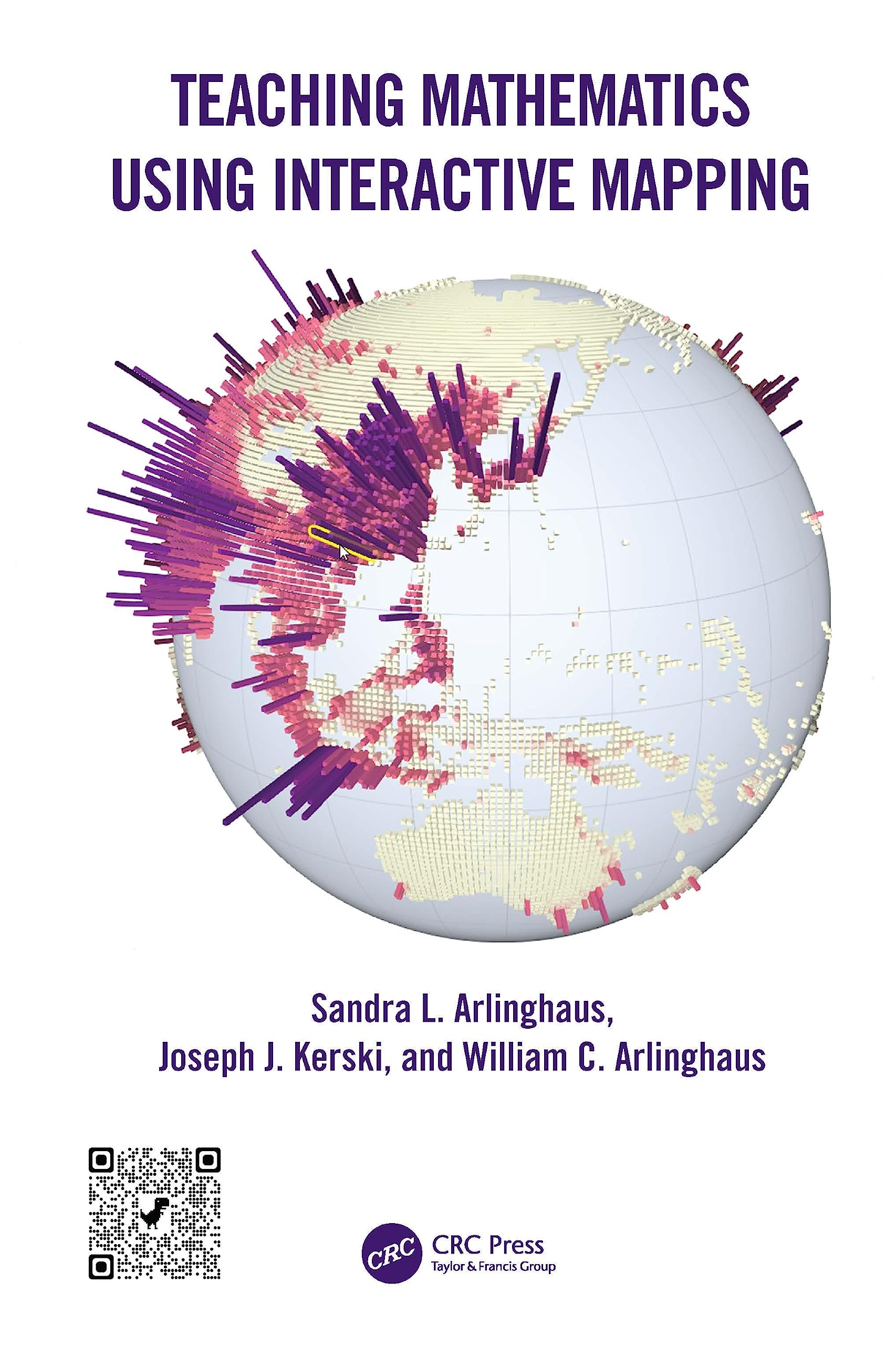
Review of Teaching Mathematics Using Interactive Mapping
By Sandra L. Arlinghaus, Joseph J. Kerski, and William C. Arlinghaus
CRC Press, 2024
249 pages (includes many maps & diagrams)
Softcover: $66.99, ISBN 978-1-03-230533-2
Hardcover: $160.00, ISBN 978-1-03-230532-5
eBook: $61.99, ISBN 978-1-03-261402-1
Review by: Michael Sparks, The Outlaw Ocean Project
In an era where literacy with data science, with artificial intelligence, and with other emerging technologies have become fundamental workplace requirements, the foundations of mathematical understanding have never been more crucial. Teaching Mathematics Using Interactive Mapping addresses this contemporary challenge by offering an innovative approach to mathematical education through the lens of cartography. Rather than following the traditional textbook format, the authors have crafted what they describe as a “buffet of approaches” (xii) designed to help instructors navigate and overcome common pedagogical roadblocks in mathematics education.
The book’s premise rests on a compelling observation: that maps serve not only to show where things are but to explain why they are where they are. This spatial reasoning—that maps fundamentally take our vast, complex world and, through mathematical operations, shrink and distill it into navigable, understandable representations—provides an ideal platform for exploring mathematical concepts. The authors leverage this relationship to create bridges between abstract mathematical concepts and their real-world applications, aiming to transform traditional stumbling blocks into opportunities for student achievement.
Structured as an alternating series of “math” and “map” chapters, the text progresses from fundamental concepts like fractions and decimals through to more complex topics including central tendency, variation, earth measurement, coordinate systems, set theory, and hierarchical relationships. This organizational approach allows for multiple perspectives on each concept, creating what the authors term a “repetition from different vantage points” (xi) that promotes deeper understanding and eventual mastery. The text acknowledges that aligning the usual linearity of mathematical curricula with a non-linear presentation of mapping concepts creates inevitable gaps, but uses these multiple viewpoints as a strategy to bridge such discontinuities.
The text excels in its diversity of case studies and applications, drawing from an impressive array of data sources including national statistics, scientific agencies like NASA and the UN Environmental Food Programme, local governments, academic institutions, and private companies. This variety extends to data formats as well, with students encountering real-world examples in spreadsheets, images, GIS vector files, and PDFs—precisely the kind of diverse data ecosystem they’ll navigate in their professional lives.
The authors demonstrate considerable skill in selecting illustrative examples that highlight the real-world significance of mathematical precision. One particularly effective early example (26–28) examines the impact of decimal precision in coordinate systems, showing how reducing decimal places in latitude/longitude coordinates progressively distances a point location (in this case, the Eiffel Tower) from its topologically correct position, providing a concrete demonstration of why precision matters. Another compelling illustration comes through the book’s treatment of the coastline paradox, which demonstrates how mathematical concepts intersect with both geography and international relations. The authors explain how the measured length of a coastline (or of any irregular border) increases as the measurement scale becomes more detailed—raising provocative questions about what constitutes the “true” length of a geographic feature. They skillfully connect this to historical events, citing Lewis Fry Richardson’s research in the 1950s on the relationship between border length and warfare probability, which noted the intriguing case where Portugal and Spain reported significantly different lengths (987 km versus 1214 km) for their shared border. This kind of example (166–168), which links mathematical concepts to both geographic phenomena and human conflict, exemplifies the book’s ability to spark curiosity and encourage independent exploration—a key goal of the text.
The practical applications are particularly compelling. A standout example (176–179) analyzes Paradise, California’s 2018 Camp Fire using mathematical and geographical analysis to examine how terrain affected both fire spread and evacuation efforts. This case study powerfully illustrates how mathematical understanding can literally become a matter of life and death in disaster scenarios. Another compelling example walks readers through the day-to-day work of a GIS analyst, examining flood and landslide risks in Boulder, Colorado.
The book presents an ambitious vision for digital integration, offering web-accessible materials that require no logins or specialized mapping expertise. However, the implementation of this vision proves problematic. The book relies on lengthy, unwieldy URLs full of seemingly random characters that readers are unlikely to easily type correctly. A more user-friendly approach, such as a dedicated website with organized, easy-to-access hyperlinks to these valuable digital resources, would have greatly enhanced the book’s practical value. While an eBook version addresses this limitation through clickable links, readers of the physical edition—the focus of this review—will likely find accessing the supplementary content frustrating.
The book’s “buffet” approach sometimes results in superficial coverage of important topics. The treatment of trigonometry is especially disappointing—while the text presents graphs of all six trigonometric functions (sine, tangent, secant, and their co-versions), it fails to provide even basic explanations of what these functions represent or of their conceptual significance. This oversight directly conflicts with the book’s mission of making mathematical concepts more accessible and understandable. There are also occasional editorial oversights, such as a reference on page 97 to a “traditional approach to that subject here (link)” where “link” appears as plain text rather than a URL.
From a cartographic perspective, too, there were missed opportunities to delve deeper into the rich complexity of mapping itself. For instance, the book could have explored the mathematical foundations of more advanced cartographic concepts such as the relationship between coordinate systems and map projections. A fascinating example would be examining how the mathematics of the Universal Transverse Mercator (UTM) projection system divides the Earth into zones and applies complex coordinate transformations—a perfect real-world application of both trigonometry and coordinate geometry that would demonstrate to students how mathematical concepts underpin modern mapping systems. To be fair, the book does lightly touch on the UTM system, but it is a rich topic that could be mined more deeply. Moreover, the mathematical principles behind terrain analysis, such as calculating slope and aspect from elevation data, could have provided excellent examples of practical calculus applications. On the other hand, these more advanced cartographic concepts could form the basis for an expanded or follow-up edition, one that might bridge the gap between introductory mathematical concepts and the sophisticated computational geometry that drives modern geographic information systems.
As a resource for mathematics instructors, the book provides valuable starting points and novel approaches to teaching mathematical concepts. However, while it offers numerous real-world applications, the text’s approach to student engagement varies in effectiveness and ultimately somewhat undershoots its potential. Some exercises, such as a compelling exploration of global population patterns (106–110), successfully demonstrate the power of spatial analysis through open-ended investigation. In this example, students compare population visualization methods, examining both 3D extruded grid cells and binned tessellations, while considering how different filtering approaches reveal distinct patterns in population density. Such thoughtful, exploratory exercises effectively demonstrate the practical value of mathematical concepts. However, not all of the exercises and examples are anywhere as strong as this, leaving some sections struggling to address even the common student question of “when would I use this?” The book serves better as a source of teaching ideas than as a comprehensive solution to mathematics education challenges.
All three authors hold PhDs and have extensive teaching experience. Dr. Sandra Arlinghaus brings expertise in mathematical geography from the University of Michigan, Dr. William Arlinghaus contributes decades of mathematics teaching experience from Lawrence Technological University, and Dr. Joseph Kerski has worked across multiple sectors implementing geotechnologies in education. Given the authors’ considerable academic credentials and wealth of classroom experience, the inclusion of concrete, ready-to-implement lesson plans would have significantly enhanced the book’s practical value for educators. Sample lessons could have demonstrated how to effectively integrate the book’s “buffet of approaches” into existing mathematics curricula while providing concrete examples of successful implementation strategies. It is worth noting that the authors seem to deliberately avoid targeting a specific learning level. Several of the book’s short-comings stem from this unfocused approach and, perhaps, could be resolved by narrowing its aims to a particular education level.
Despite these limitations, Teaching Mathematics Using Interactive Mapping represents an important contribution to both mathematics and cartographic education. Its innovative approach to using cartography as a framework for mathematical understanding offers instructors new tools for engaging students and demonstrating the real-world relevance of mathematical concepts. While it may not serve as a standalone solution, it provides valuable supplementary material for educators seeking to enhance their mathematical instruction through spatial thinking and real-world applications.