DOI: 10.14714/CP107.2023
© by the author(s). This work is licensed under the Creative Commons Attribution-NonCommercial-NoDerivatives 4.0 International License. To view a copy of this license, visit http://creativecommons.org/licenses/by-nc-nd/4.0.
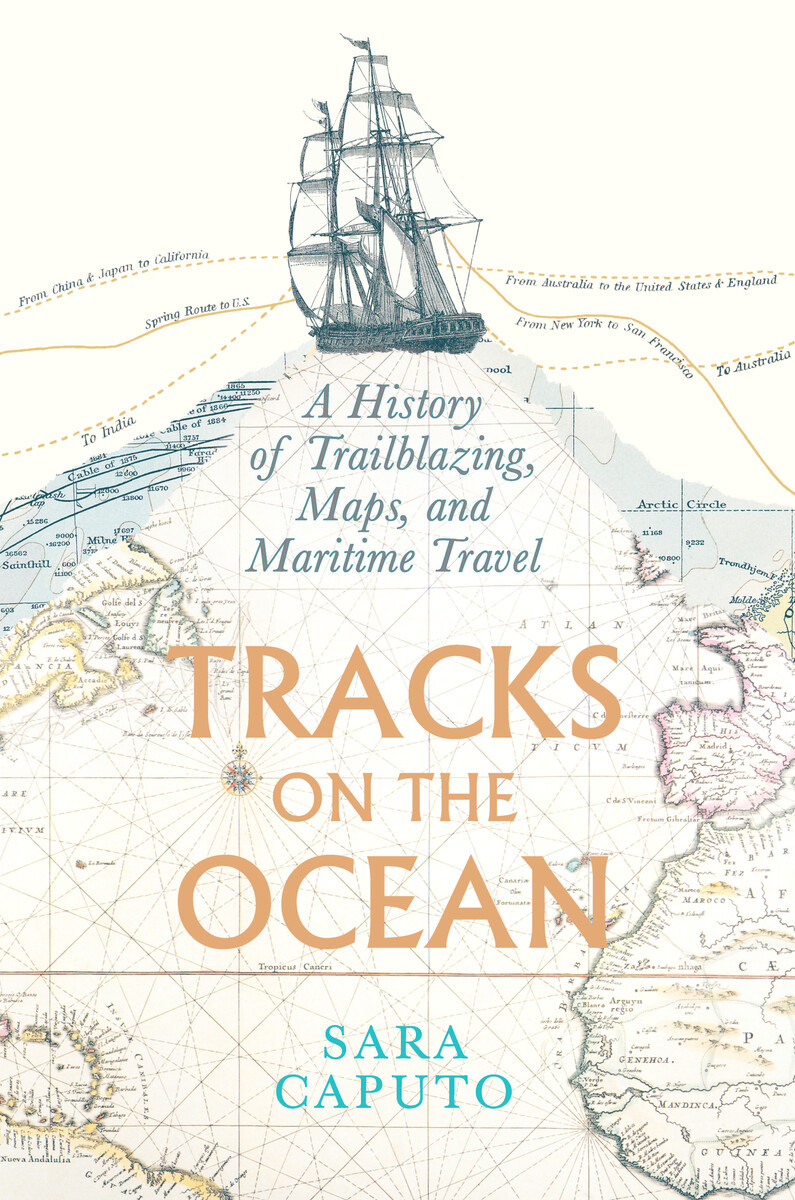
Review of Tracks on the Ocean: A History of Trailblazing, Maps, and Maritime Travel
By Sara Caputo
The University of Chicago Press, 2024
310 pages, 60 figures, 24 color plates
Hardcover: $37.50, ISBN 978-0-226-83792-5
Paperback: $20.00, ISBN 978-0-226-84554-8
eBook: $36.99, ISBN 978-0-226-83793-2
Review by: Eric D. M. Johnson, Virginia Commonwealth University
In Tracks on the Ocean, Sara Caputo focuses on the development and meanings of “journey lines” or “tracks”—those representations of individual maritime journeys that began to appear on European maps and charts at the start of the sixteenth century. While she does recount the history and development of these lines as a map convention, she is most interested in exploring the ways that “the ‘track’ has embedded itself in Western understandings of space and movement” as “a practice, a convention and a conceptual and visual device” (3).
In order to take us with her on that exploration, Caputo—senior research fellow and director of studies in history at Magdalene College at the University of Cambridge—has compiled a remarkable body of research that she has cooked down into a relatively brief two hundred pages of narrative. That said, those pages are not an easy read: this is a university press publication written by an academic and, primarily intended for fellow academics. It covers a great deal of territory, time, symbolism, and human conceptions of the nature of space; often dashing back and forth between those ideas within the span of a few paragraphs.
The book is divided into seven chapters. The first offers a relatively straightforward overview of the ways in which the (primarily Western) world conceived of and represented records of travel in ancient and medieval times. Rather than adopting the Euclidean, top-down, “aerial” view we so often use today, the ancient Greeks and Romans instead “usually saw their surroundings in a linear, ‘path-shaped’ way: from their own point of view” (19). Caputo describes this conceptual approach as “hodological”—experiencing, and mapping, space as “lived”—as opposed to “cosmographic,” where space is “represented.”
In the centuries that followed Classical antiquity—even up to the fifteenth and early sixteenth centuries—the world was primarily depicted hodologically in both text and graphics, and “view from above” graphic representations of individual tracks were not yet to be found. In the late thirteenth century, however, “two separate and decisive innovations prepared the ground for tracks. Within the same decade or so, in the 1290s, we encounter both the first proper storytelling route on a map and the first instance of maritime mapping” (35, emphasis in original). The ground is also thereby prepared for the remainder of the book.
In the second chapter, Caputo examines the sixteenth century maps she sees as the earliest identifiable examples of ship’s tracks—representing, for the first time, an individual vessel’s journey on the seas—and further explores their antecedents. She suggests four roots for the emergence of these journey lines: the well-establish practice of representing paths and roads on land; the rise of portolan charts, a form of nautical chart characterized by the presence of rhumb lines that trace compass directions; the pictorial tradition of inserting a drawing of a ship in the middle of the sea; and a similar tradition of showing journey lines in Asian mapping (although, for this fourth root, the author is careful to tease out the differences between Eastern and Western practices). The remainder of the chapter tells of the evolution of journey tracks and their representation, the pivot from the hodological viewpoint to a cosmographic one, and the challenges of representing journeys taken across a three-dimensional sphere on two-dimensional maps.
Having established that, by the eighteenth century, the ship’s track was a well-developed technical tool, Chapter 3 moves from maps to an examination of the history and meaning of the on-board practice of recording a ship’s journey rather than the after-the-fact recordation outlined in the previous chapter. “The original manuscript line . . . was drawn alongside the voyage—by the voyage, we could almost say, as the ship itself turned into a scientific instrument”—and not only a scientific instrument, but an instrument of empire. Thus, “[a] route line was no longer just the means of representing human dominion over the seas, but the means of establishing it, in real time” (77, emphasis in original). The fraught constructs of “exploration” and “discovery” are examined in detail, as are their attendant legacies of violence against the indigenous populations that occupied the places Europeans so often had seen as “virgin.”
The fourth chapter turns away from technical and practical matters of the development of ship’s tracks and considers the ship track’s role in storytelling—blending, as they do, “the supposed trustworthiness of science with the drama of fiction, the ‘objectivity’ of instruments with the glitter of personality” (102). This chapter explicates the rise in popularity of maritime stories in eighteenth- and nineteenth-century Europe and the United States and the ways that tracks helped tell those tales, becoming themselves “article[s] of popular consumption” (110). Tracks were well-positioned to make inroads at a time—especially the in the Victorian era—when the sciences themselves were popular in the middle-class public sphere.
Chapter 5 turns again to the practicalities and technicalities of recording tracks, only noting that the emphasis in the nineteenth century changes from “the mapping of territory” to “the mapping of individual behaviour.” In other words, “[o]ver the course of the nineteenth century, we witness a major change in the nature and function of tracks: they evolve from tools of surveying into tools of surveillance” (138–139). The work of an individual navigator can now be judged as individual output. Example maps are offered—from eighteenth-century storms to World War II rescues at sea—in which the track is used by outsiders to examine and question specific choices being made by individual actors.
Chapter 6 concerns the tracks drawn—not by naval personnel, as so many of the previous examples had been—but by laypeople: passengers and crew of steamship lines and other private persons. These would be their own tracks, not just those of “heroes, explorers, and sailors” (167). Having introduced steamships to the story, Caputo travels for a while with these new vessels and their modern ability to travel in speedy straight lines, ignoring adverse or calm wind, exploring their meaning and symbolism and their role in slicing up the sea in new ways. She observes that “these weren’t simply shipping lanes, but shipping lines” (176), set routes running on set schedules for the first time ever. Here, too, we learn about the creation of the Suez Canal and the laying of transoceanic cables—both of which are forms of track—along with their significance to trade and importantly, if briefly, their environmental impact.
The seventh and final chapter further emphasizes the individual, only now the focus isn’t on “relatively powerful white men,” but is instead those who were so often left off the pages of received histories. This chapter focuses on “put[ting] the track into its context: historically, who got to claim tracks, who didn’t, and why?” (192). We spend some time with a look at women’s own experiences as track-makers, wayfinders, and participants in the maritime world. Caputo also touches on the indigenous peoples who assisted and at times accompanied the European explorers, in particular considering indigenous seafarers in the Pacific at some length. She concludes by considering tracks as “countertracks”: “not only can they be made by new, unintended users, but they can also be read by unintended users” (208). Tracks can help a “fresh eye” to see and learn new things, such as the environmental impact of all these ship journeys.
These many stories and ideas are supported throughout the book by a remarkable degree of research in archives, books, and journals spanning sources in English, Italian, Spanish, French, and more. Some 650 endnotes, a good half of which reference multiple works, point to the depth of Caputo’s documentary effort. Many of the maps she references are available digitally through URLs included in the footnotes and credits. There are sixty black and white figures, most of them maps or charts, and twenty-four color plates of particularly significant cartographic works.
Tracks on the Ocean offers a good deal of interest to the engaged reader. The sheer scope of the effort is impressive, touching upon two millennia in the history of journey tracks and exploring scores of ideas about what these tracks do and might mean. Again, this work is not simply Caputo’s idle thoughts alone: she has pulled hundreds of resources together to support her narratives. Any specific aspect that might interest a given reader—whether it be compelling stories drawn from twentieth-century naval records or the idea that tracks tracing the journeys of the famous fifteenth-century Chinese admiral Zheng He were more illustrations of common sea routes than they were tales of his individual exploits—can be chased down through her endnotes.
Caputo does a lovely job of introducing new ideas through lively historical vignettes, which put individual faces on what might otherwise be abstract concepts. And speaking of illustration, the maps, plates, and other figures she includes alongside the narrative are very well-chosen indeed, bringing to life the ideas she explores and the history she shares. Indeed, several times I found myself wishing I could zoom in, the better to see the wonderful cartographic work being shared to emphasize a given point. (Thank goodness for those URLs in the illustration credits!)
I appreciated, too, the number of themes that threaded their ways throughout the work. She often touched on the ocean as an apparently “trackless” place, expounding on how it was experienced and felt in different eras and by different people. Ideas of exploration and discovery, including how those notions developed and for whom they were so often reserved, helped frame a number of points. That journey tracks were not merely technical or symbolic tools but could and should in fact be considered cultural artifacts is the compelling driver of the whole work.
But all that said, not everything about the book was successful. As mentioned at the outset, this is very much an academic book written by an academic, evidently for an audience of her peers. At times it felt very much that it was written to be in conversation with other specific, perhaps even named, specialists rather than for—as she proposes in her acknowledgments (219)—a broader audience. Perhaps I shouldn’t ding a university press publication too strongly in that regard, but it feels like a missed opportunity to widen her reach.
A few times, too, Caputo seems to promise depth in areas that in fact only got light treatments. The early journey maps of the East, for instance, came up a few times, but she did not explore non-Western mapping in real depth. She also failed to close the deal on some of her arguments: staying with the East, again, in Chapter 2, she mentions Asian maps as one “root” of Western journey maps, but there was no strong evidence of an actual connection offered. Another area that got several mentions but no deep analysis was the environment and its relationship with ships’ tracks (real or imagined). It was almost as if she felt—understandably—that it would be improper not to talk about environmental impacts in the twenty-first century, but she failed to assemble the evidence for her ideas about it to the same degree she did for her earlier discussions. This same incompleteness stood out in the lack of discussion of how race and class excluded people “from the club of legitimate track-makers” (198).
Finally, as a practical book-related matter, I found it frustrating that this deeply-researched book didn’t have a standalone bibliography. The endnotes were of the standard form of “first reference gets full citation and any following get a shortened author/title/page citation.” Because she looked at so many works and sometimes circled back to them well after their initial introduction, it often became very hard to find the full publication she was referencing.
At times, too, Caputo failed to give a quick capsule definition of the concepts she introduced. For instance, she wrote, “to some extent, hydrographical tracks were intentionally ‘universal’ (at least within the European world, and its narrow Enlightenment definitions of ‘universality’)” (121) without ever explaining what “Enlightenment definitions of ‘universality’” actually were. Similarly, at one point she writes that Admiral Hugh Cloberry Christian “inevitably acquired a certain reputation as a Jonah among the most superstitious seamen” (142) without ever explaining that a “Jonah” is a person believed to bring bad luck, especially on board a ship. There are also a few examples in which she emphasized in her text the wonderful qualities of a specific map that illustrated a point she was making, but the map itself never appears as a figure; it may be that permissions couldn’t be secured, but it is frustrating not to see what she sees.
As impressive a research feat as this book is, and as compelling as many of the points and vignettes are, I found it to be a little too broad and scattered to be truly engaging. Caputo jumps from idea to illustration to historical personality and back and forth again, often making it a challenge to follow the main threads of her points. The book offers a little bit about many things, and as such, many readers will find tidbits that will interest them. But ultimately, it felt like a mosaic built of a large number of glittering or colorful or strikingly textured pieces, but one whose overall picture, when the viewer steps back, can never be clearly made out.