DOI: 10.14714/CP107.2059
© by the author(s). This work is licensed under the Creative Commons Attribution-NonCommercial-NoDerivatives 4.0 International License. To view a copy of this license, visit http://creativecommons.org/licenses/by-nc-nd/4.0.
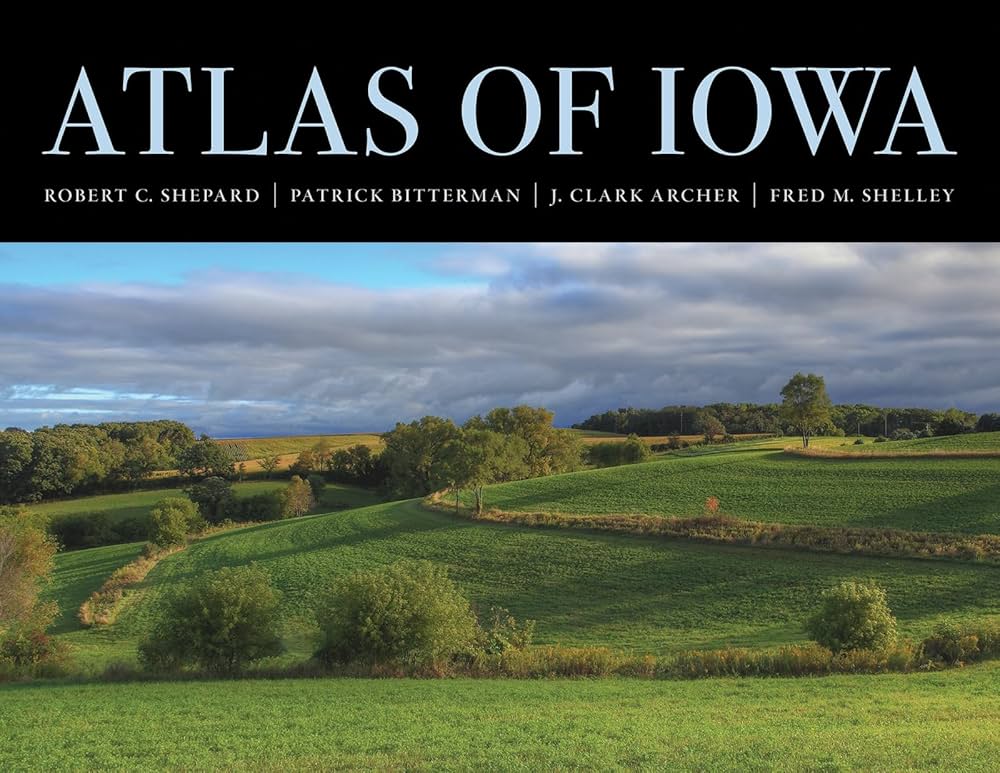
Review of Atlas of Iowa
By Robert C. Shepard, Patrick Bitterman, J. Clark Archer, and Fred M. Shelley
University of Iowa Press, 2024
240 pages, 2 color photos, 2 color images, 267 color maps, 48 color figures
Softcover: $39.95, ISBN: 978-1-60938-959-8
eBook: $39.95, ISBN: 978-1-60938-960-4
Review by: Atlas (Chenxiao) Guo (he/him), University of Wisconsin–Madison
Do you know Iowa? Whether you’re entirely unfamiliar with the area and looking for a broad overview of its natural and cultural landscapes, or a resident eager to deepen your connection to the state you cherish, the Atlas of Iowa is an essential read. This book provides a comprehensive look at Iowa’s vibrant tapestry through a spatial and temporal lens. Through the authors’ richly illustrated narrative, readers are invited to embark on a captivating virtual journey across Iowa, thoughtfully divided into six well-structured chapters.
The first chapter, “Introduction and Physical Geography,” lays the groundwork for understanding the state. It begins by exploring the origin of Iowa’s nickname, the Hawkeye State, followed by the histories of some of its higher education institutions, including how they named their athletic teams: University of Iowa (Hawkeyes: honoring Chief Black Hawk, a Sauk leader), Iowa State University (Cyclones: another term for tornadoes), and Iowa Western Community College (Reivers: historical Missouri River pirates). It also examines the symbolism of the state flag and unpacks the possible meaning of the word Iowa, “beautiful land,” which is usually believed to originate from a Native American term approximated in French as “Aiaouez.” From this engaging introduction, the chapter seamlessly transitions into a concise yet comprehensive overview of Iowa’s physical geography. Topics such as landforms and geology, climatology, vegetation and land cover, and renewable energy (particularly wind power) are presented with clarity and precision. The chapter also provides valuable insights into natural disasters, including tornadoes, floods, and derechos, emphasizing their significant impact on Iowa’s landscape and communities.
The second chapter delves into the history of Iowa, vividly brought to life through a rich collection of historical and modern maps. The journey begins over 10,000 years ago, focusing on both prehistoric Iowa and on archaeological sites that reveal pre-contact Native American settlements. It then transitions to the era of Euro-American exploration and colonization that began in the fifteenth century—when Iowa was claimed at different times by both France and Spain—illustrated with historical maps from the Library of Congress. The narrative continues with Iowa’s time as a US territory, highlighting its capitals, Burlington (until 1841) and Iowa City (until 1846). Finally, the chapter chronicles Iowa’s path to statehood, detailing key moments such as the statehood votes of 1845–1846 and the relocation of the capital from Iowa City to Des Moines in 1857. The chapter explores a wide range of important themes, such as hydrologic systems, population migration, railroad expansion, and the surveying of counties and townships, with thematic maps providing valuable context and enhancing readers’ understanding of each.
The third chapter, “Demographics,” builds on the historical narrative of Chapter 2 and provides a solid foundation for the human geography topics explored in later chapters. It opens with broad discussions, including county-level population density maps dating back to 1840 and detailed census tract maps from the 2020 census. The chapter then examines the age structure of Iowa, highlighting trends in the proportions of residents under 15 and over 65 since 1930. It also delves into Iowa’s racial and ethnic diversity, featuring maps that illustrate the distributions of foreign-born Iowans, as well as the Native American, Asian, Hispanic, and Black populations, alongside Iowans of European ancestry. For the latter, particular attention is given to the German, Czech, Scandinavian, Irish, English, and Dutch communities, offering valuable insights into the rich cultural heritage that defines the state’s identity.
The fourth chapter, “Agriculture,” shifts focus to Iowa’s rich agricultural history and evolution, illustrated through county-level choropleth and proportional symbol maps, as well as by line charts. It traces changes in agricultural practices from 1850 to the present, with maps at fifty-year intervals. Topics range from oats and horses to corn, soybeans, wheat, hogs, cattle, and sheep, and provide a comprehensive overview of the state’s agricultural staples. The chapter also highlights the Century Farm Program, run by the Iowa Department of Agriculture and Land Stewardship. This program celebrates farms that have remained within the same family for over a century, reflecting the deep roots of agriculture in Iowa. Additionally, it examines the direct and indirect costs of the agricultural system, offering insights into the challenges and complexities of modern farming in Iowa.
The fifth chapter, “Urban and Economic Geography,” begins with an exploration of Iowa’s transportation networks, including highways, railways, and river routes, highlighting their critical role in the state’s development. The focus then shifts to urbanization, examining the growth of incorporated places and the classification of settlements as rural, micropolitan, or metropolitan. Economic themes are visualized through county-level maps of employment trends across eight industry categories for 1950 and 2000, as well as census tract data from the 2016–2020 period. The chapter also delves into income disparities, poverty levels, and both historical and contemporary agricultural trade and processing activities, providing a comprehensive view of Iowa’s economic geography.
The sixth and final chapter, “Political, Religious, and Social Patterns,” expands the atlas’s scope to include various human dimensions. It begins with an in-depth visualization of Iowa’s political landscape from 1848 to the present, with detailed maps showing US presidential election results, congressional districts, and popular vote tallies for the House of Representatives. The Religion section provides a rich historical overview of twelve religions (including denominations), and their spatial distributions across the state. Education is another key focus, with maps depicting school district boundaries, college and university enrollments, and the proportion of the population holding higher education degrees. Health-related topics are also explored, including hospital capacities, premature death rates, and health insurance coverage. The chapter concludes with some examples of modern cultural trends, exploring Iowa’s contributions to cycling sports, baseball, literature, and film, demonstrating the state’s national cultural influence.
In summary, this atlas provides a comprehensive overview of Iowa, covering aspects ranging from physical geography, history, population, and agriculture to urban development, economy, politics, religion, and society, all viewed through a spatiotemporal lens. The scale of the project is evidenced by the broad coalition behind it—from institutional sponsors to contributing scholars, from state agencies to archival institutions—whose support enabled the years-long process of collecting, designing, and refining the atlas.
Although this is titled as an atlas, the text forms the foundation of its content, rather than the maps. The narrative is detailed and objective, and provides in-depth explanations of the topics it covers. Readers who invest the time and effort to thoroughly explore the text will be captivated by its richness and depth. Notable examples include the examination of Iowa’s residents of European descent (Chapter 3), the stories behind the Century Farm Program (Chapter 4), the rise and fall of railway transportation (Chapter 5), and the comparisons amongst Iowans of diverse religious backgrounds (Chapter 6). These sections, even alone, serve as concise and insightful history texts.
Any text-heavy atlas faces the challenge that visually oriented readers who only look at the maps will overlook the accompanying text and thus miss some significant explanatory context, nuance, or even some entire topics. This means that the maps must, by themselves, convey the same narrative—even if somewhat less fully—as accurately and faithfully as possible without textual support, while at the same time minimizing potential bias. From this perspective, the book is undeniably successful. Each map is thoughtfully crafted, with carefully chosen attributes and symbols, and they are seamlessly integrated within and across chapters. Together, they contribute to the unified theme of presenting a dynamic, comprehensive, and authentic portrait of Iowa, both past and present. The authors’ expertise and distinguished reputations in the field are evident in their skillful handling of massive data processing and presentation tasks.
The majority of the visuals in the book are bespoke maps, thoughtfully complemented by a curated selection of rare historical maps, photographs, remotely sensed images, and statistical charts. These diverse elements work together to create a vivid and immersive sense of historical authenticity that adds depth and texture to the narrative. The seamless integration of modern and historical imagery not only enriches the storytelling, but also allows readers to draw meaningful connections between the past and present. There is a unique satisfaction in comparing these custom maps with historical maps and records, and in recognizing their remarkable consistency.
From a cartographic perspective, the book adopts traditional, yet refined, mapping techniques that harmonize effectively with the detailed textual content, enhancing both accessibility and credibility. For example, although many readers may find choropleth maps to be the most visually appealing and familiar way to represent thematic data, in the Atlas of Iowa they are exclusively used to represent percentages, while proportional symbols are employed to depict raw data, thus avoiding the potential biases that can arise from normalizing variables by area or population. The authors choose their symbology for each map to prioritize accuracy and strive to minimize distortions, showcasing a balance between aesthetic presentation and faithful representation of the data.
The authors, drawing on their rich expertise in cartography and GIS education (one, for example, is an emeritus professor of geography) as well as atlas production (two had coauthored the Atlas of Nebraska and Atlas of the Great Plains), applied a relatively traditional approach to represent the data rather than following trends in visual innovation. It seems to me that their intention was to provide a thorough, plain, and enduring reference work; emphasizing accuracy and comprehensiveness over novelty—offering a solid body of documentation that can stand the test of time rather than a showpiece of innovative or experimental forms of presentation.
That they consistently went with more pedestrian cartographic solutions will likely disappoint readers hoping for an atlas employing more creative, novel, or decorative visual styles. Such readers should, however, consider the reasoning behind this choice. While fancy presentations might catch the eye, they are likely better suited as supplements or alternative formats supporting, rather than replacing, the more conventional maps presented here. One must take into account risks that excessively creative designs might hinder accessibility for visually impaired readers or for those with limited familiarity with complex map styles. That said, the lack of creativity might perhaps have been taken too far on some of the maps, many of which rely on default GIS software settings, and show limited graphical refinement. Incorporating visual enhancements—such as improving the clarity of densely populated areas on census tract level maps or applying customized design elements tailored to specific mapping topics—could significantly enhance the reader’s experience. Such adjustments would not only make the maps more visually compelling but also improve their usability and interpretability.
Creativity, though, is certainly not entirely absent from the atlas. A large number of custom cartographic symbols are employed on various maps, and their design is both understated and far from rigid. Examples such as the unique symbols used in the tornado maps (Figure 1-11), the innovative combination of proportional point and line symbols to depict population migration (Figure 2-14), the overlay of hydrographic layers on historical place maps (Figure 2-21) and population maps (Figures 5-5 to 5-7), are all well-conceived and refreshing. That said, some tempting opportunities for adding depth and context to the maps were left unexplored, such as careful incorporation of a shaded relief layer or of urban area overlays where appropriate. Notably, the atlas does not rely solely on cartographic representations. Non-cartographic statistical charts play a significant role in visualizing relevant variables and supporting the narrative themes, adding diversity to the visual content and enriching the reader’s understanding.
In the concluding section of Chapter 6, the Atlas of Iowa extends beyond the traditional geographical atlas topics of topography, geology, resources, and demographics to explore diverse areas such as cycling, literature, film, and baseball, offering fresh angles to appreciate and celebrate Iowa, and adding depth and variety to its portrayal. It is too bad that the excursion is so brief: inclusion of even more diverse and non-traditional topics as a standalone chapter could have further enriched the atlas. Nonetheless, by concluding with these distinctive themes, the authors leave both the atlas and the state of Iowa with an open-ended narrative—one that is gently extended by the invitation in the epilogue to continue the story. A truly inspiring prospect!